

National Pesticide Core Training & Practice
Build the knowledge that travels with you—then finish with your state.
Strengthen your understanding of pesticide labels, safety, exposure, PPE, environmental protection, IPM, formulations, equipment, storage, spills, and professional decision-making through focused practice and realistic simulations.
Important: National Core does not represent a single official national exam, license, or certification. Every candidate must still follow the current requirements, manuals, laws, categories, fees, and examination procedures of the applicable state, territory, tribe, or federal certifying authority.
A broad foundation—not a substitute for state certification
Federal standards establish baseline competency expectations for restricted-use pesticide applicators, while individual certifying authorities administer their own programs and may impose broader or stricter requirements.
Self-paced practice covering widely shared pesticide Core concepts.
Orbait does not claim that one exam or license applies nationwide.
An internal Orbait estimate of commonly shared foundational material—not a government statistic.
Review your authority’s current manual, laws, categories, eligibility, fees, and procedures.
When National Core may be the right starting point
Choose a state-specific Orbait track whenever one is available for your jurisdiction. National Core is designed as the next-best foundation when a dedicated state program is not yet offered.
Your state is not available yet
Build transferable knowledge now instead of postponing all preparation.
- Learn recurring pesticide label and safety principles.
- Practice exposure, PPE, environmental, IPM, and equipment decisions.
- Develop study habits before adding state-specific laws and procedures.
You want a stronger foundation first
National Core can help new technicians become comfortable with the language and logic of pesticide work before they begin a jurisdiction-specific manual.
You train employees across several states
Employers can use National Core to reinforce common safety and decision-making concepts across a multi-state workforce, then assign the correct local requirements separately.
A state-specific track is available
Use the dedicated state track instead. It is designed around that jurisdiction’s terminology, exam structure, rules, fees, categories, and certification pathway.
What National Pesticide Core training covers
The program organizes broadly transferable concepts into focused topics that support safer, more informed pesticide decisions across jurisdictions.
Labels & legal use
Directions, precautions, sites, rates, signal words, restrictions, and why label language controls pesticide use.
Toxicity, exposure & first aid
Routes of exposure, acute and chronic effects, symptoms, emergency response, decontamination, and first-aid priorities.
PPE & applicator safety
Gloves, respirators, protective clothing, hygiene, heat stress, inspection, replacement, and safe work practices.
Formulations, mixing & equipment
Common formulations, compatibility, measuring, mixing order, calibration principles, maintenance, and contamination prevention.
Environmental protection
Drift, runoff, leaching, weather, groundwater, sensitive sites, pollinators, wildlife, and off-target movement.
Integrated Pest Management
Inspection, identification, thresholds, prevention, monitoring, nonchemical controls, selection, and evaluation.
Storage, transport, spills & disposal
Secure storage, separation, vehicle safety, spill response, container handling, waste management, and emergency planning.
Professional responsibility
Supervision, records, communication, restricted-use concepts, accountability, and recognizing when local rules must be checked.
The material that National Core cannot standardize for you
Even when foundational concepts overlap, certification programs are not interchangeable. These details must be verified directly with the authority governing where you work.
Eligibility and certification levels
- Minimum age and experience requirements
- Apprentice, technician, applicator, dealer, or private-applicator classifications
- Required training courses or verified work experience
- Supervision and direct-supervision rules
Exam and category structure
- Number and names of categories or subcategories
- Question count, time limit, passing score, and retake policy
- Open-book, closed-book, online, or testing-center procedures
- Approved manuals and registration deadlines
State and local law
- Recordkeeping, posting, notification, and reporting duties
- Product registration and restricted-use rules
- Business licensing and insurance requirements
- Local ordinances or agency-specific restrictions
Fees, renewal, and continuing education
- Examination and certification fees
- Renewal cycles and recertification credits
- Late fees, category additions, and reciprocity
- Approved continuing-education providers
Practice, review, and understand every answer
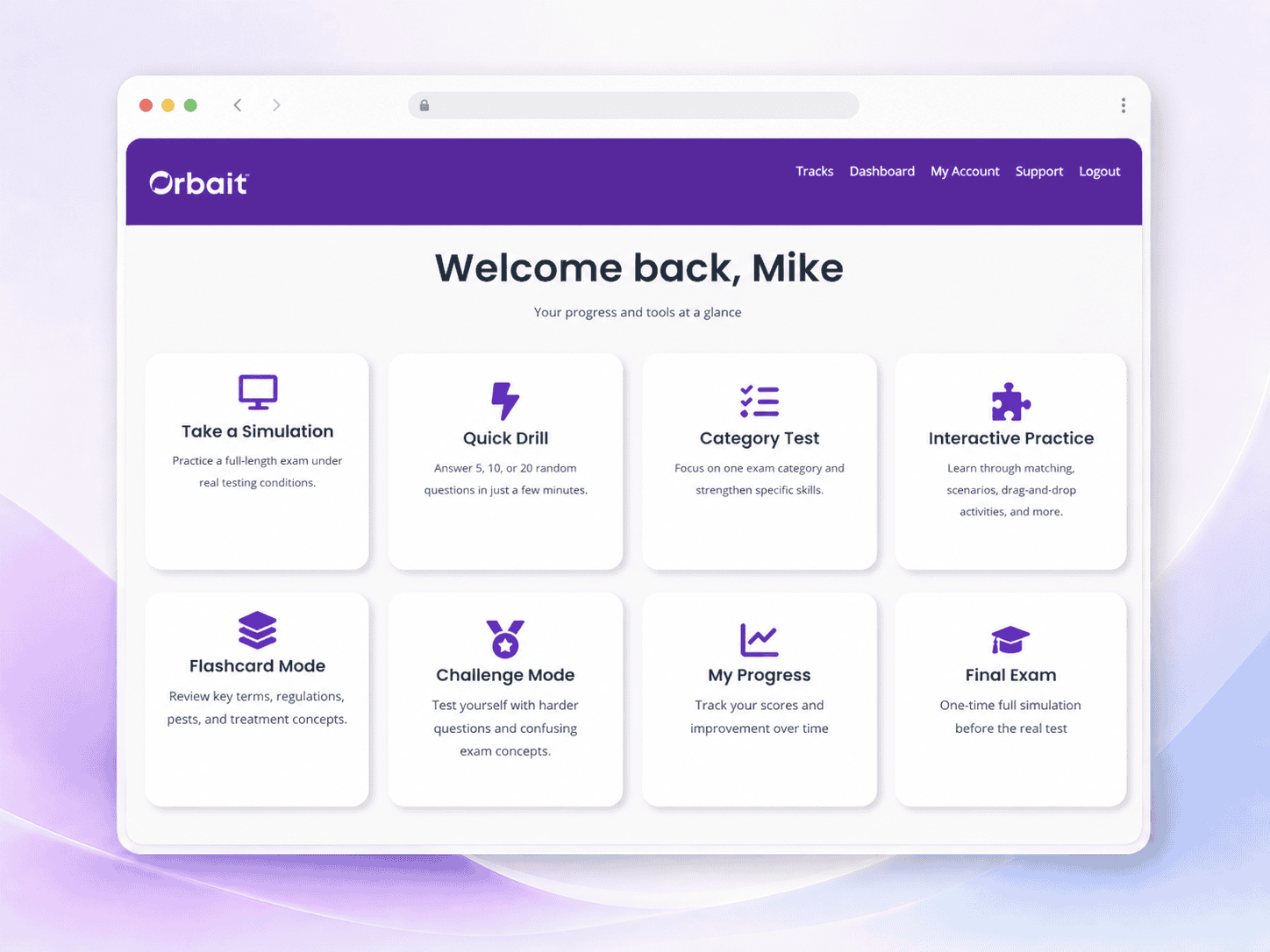
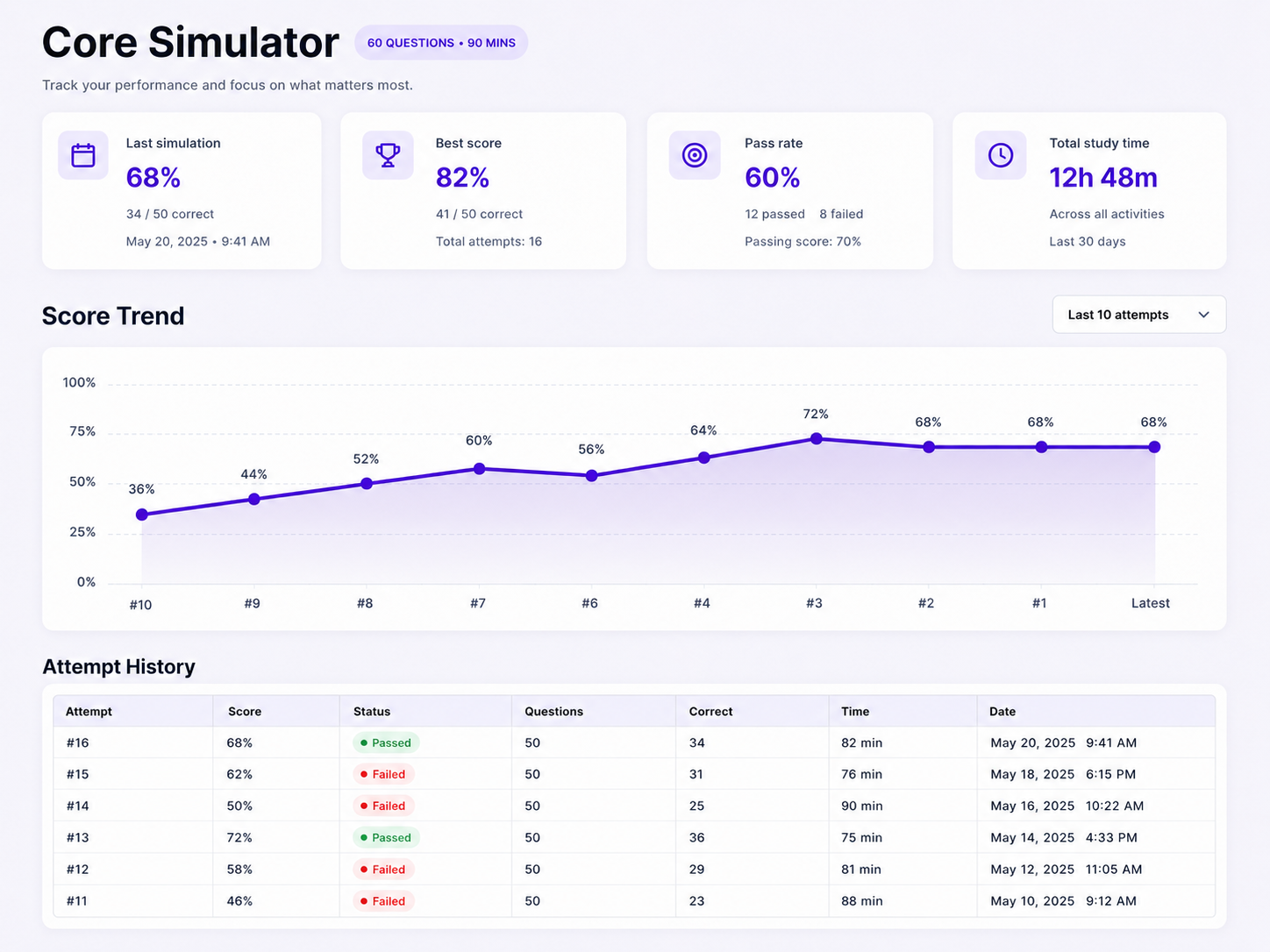
Explore the dashboard, simulation tools, performance tracking, and detailed explanations that turn broad Core knowledge into measurable progress.
Move beyond memorization
Strong pesticide decisions require more than recalling a definition. You must recognize the controlling label direction, hazard, environmental condition, or professional responsibility.
Several correct facts. One controlling action.
“During transport, a technician notices a leaking container beside clean equipment and PPE. The original label is partly damaged, the cargo area is not isolated, and the next stop is a customer site. What should be addressed first?”
Identify the governing information
Locate the label instruction, safety principle, environmental risk, or legal responsibility that controls the situation.
Prioritize people and containment
Separate distracting facts from the immediate exposure, spill, contamination, or off-target risk.
Choose a defensible response
Practice selecting the safest compliant action while recognizing that local rules may add further requirements.
Practice in more than one way
Use focused study while learning, mixed simulations while connecting concepts, and full assessments when you are ready to measure retention and decision-making.
Topic Tests & Quick Drills
Focus on labels, PPE, exposure, environmental safety, IPM, equipment, or another weak area without restarting a full assessment.
Mixed Core Simulations
Practice situations that combine several concepts and require you to identify the controlling rule or safest action.
Final Assessments & Analytics
Complete timed attempts, review explanations, revisit missed concepts, and monitor improvement over time.
Start with Core or build the complete National foundation
Choose the foundational track that matches your study goals. Every option includes six months of self-paced access, detailed explanations, focused practice, simulations, and progress tools.
National Core Foundations
Build transferable knowledge in pesticide labels, safety, exposure, PPE, environmental protection, IPM, formulations, equipment, storage, spills, and professional responsibility.
- National Core question bank and explanations
- Topic Tests and Quick Drills
- Mixed Core simulations
- Timed final assessments
- Six months of access
Structural & Rodent Foundations
Practice broadly shared structural pest and rodent-control principles, including biology, inspection, sanitation, exclusion, monitoring, devices, and account-based decisions.
- Structural and rodent question bank
- Inspection and pest-evidence practice
- Sanitation and exclusion scenarios
- Mixed account simulations
- Six months of access
Complete National Track
Connect pesticide Core foundations with structural and rodent-control practice in one complete transferable study path.
- Both complete National preparation systems
- Save $39 compared with separate purchase
- Core and structural scenario simulations
- One connected progress dashboard
- Six months of access
Official resources for pesticide applicator certification
Use these resources to identify the certifying authority and current requirements that apply to your location and intended work.
How to get certified
EPA explains who must be certified and why applicants must follow the program governing each jurisdiction.
View EPA certification guidance →Federal competency standards
Review the federal baseline standards that approved certification programs must address.
View federal standards →Find your state or territory
Locate the pesticide regulatory agency responsible for licensing and certification where you plan to work.
Find your agency →Content reviewed July 30, 2026. Certification standards, agency procedures, manuals, and jurisdiction-specific requirements can change. Always verify current information directly with the applicable certifying authority.
Questions about National Core
Is there one national pesticide applicator license or Core exam?+
No. Certification is administered by the applicable state, territory, tribe, or federal agency. National Core is a transferable foundations program—not an official national licensing examination.
Why call it “National Core”?+
The name describes a broad curriculum of commonly shared pesticide Core concepts. It does not imply that one government exam, license, or certification applies across the entire country.
Does National Core cover about 70% of state material?+
Orbait estimates approximately 70% overlap with foundational concepts commonly found in many state Core programs. This is an internal estimate, not a government statistic. Actual overlap can be higher or lower depending on the jurisdiction, manual, category, and exam version.
Should I choose a state-specific track instead?+
Yes, whenever Orbait offers a dedicated track for the jurisdiction where you intend to become certified. State-specific tracks can address local terminology, laws, exam structure, categories, fees, and certification procedures.
Can this replace my official state manual?+
No. Study your certifying authority’s current manual and official requirements. Orbait is designed for practice, explanation, repetition, and reinforcement.
Does completing National Core qualify me for an exam?+
Not automatically. Eligibility may depend on age, training, work experience, employer documentation, category selection, fees, or other jurisdiction-specific requirements.
Can employers use National Core for employee development?+
Yes, as an internal study and reinforcement resource. Employers must still provide any legally required training, supervision, documentation, certification, and continuing education.
Does Orbait issue CE credits or certification?+
No. Unless Orbait expressly identifies a separately approved program, National Core does not provide continuing-education credits, licensing credit, certification, or authorization to perform pesticide work.
How long do I have access?+
National Core includes six months of access to topic practice, simulations, explanations, progress tools, and final assessments.
Build transferable Core knowledge—then finish with your state.
Practice the labels, safety principles, environmental decisions, and professional responsibilities that support pesticide work across jurisdictions.
Start National Core